

Blog
Retatrutide vs Tirzepatide: Receptor Coverage and Comparative Research Design

For Laboratory Research Use Only — Not for Human or Animal Consumption. Not for diagnostic or therapeutic use. Must be 21+ to purchase. Retatrutide vs tirzepatide is the comparison we are asked about more than any other. They are the two most requested compounds in our catalog, and the question is always what actually separates them. The short answer is one receptor. The longer answer is what that receptor does to the shape of a comparative research programme — and that is worth setting out properly, because the two are frequently discussed as though they were interchangeable, and they are not.
What is the difference between retatrutide and tirzepatide?
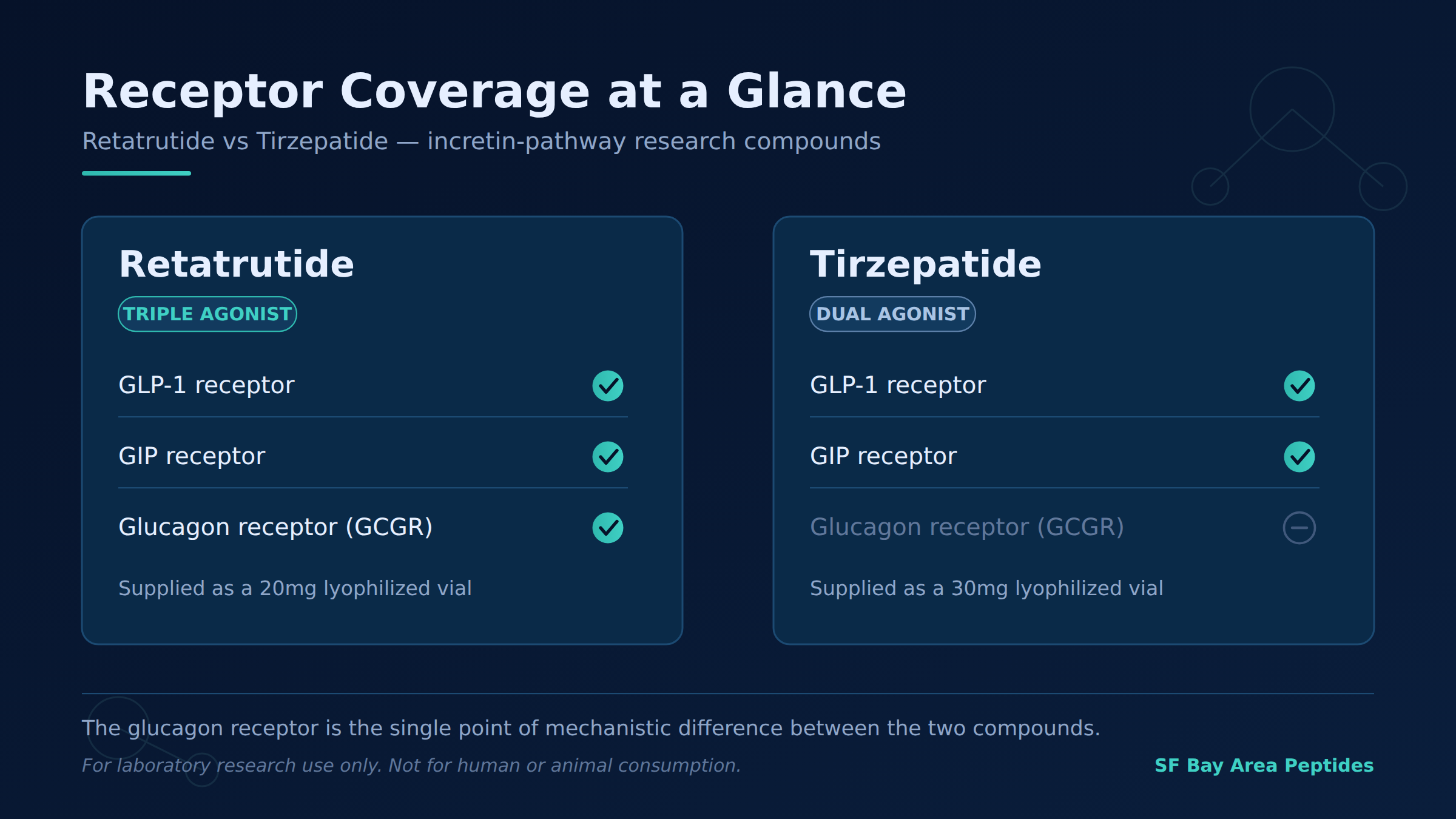
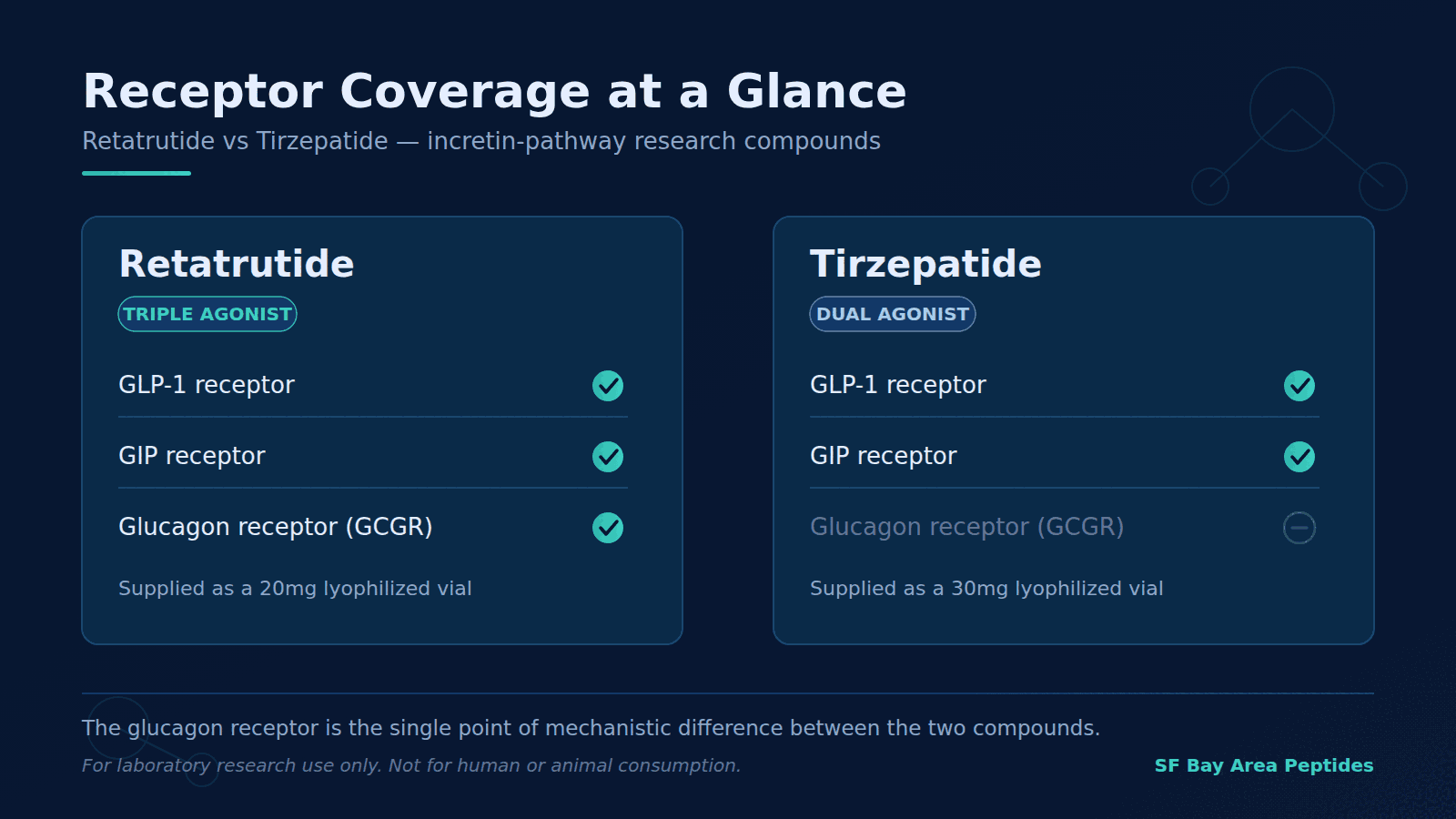
Tirzepatide is a dual agonist and retatrutide is a triple agonist. Tirzepatide engages two incretin receptors — GLP-1 and GIP. Retatrutide engages those same two plus a third, the glucagon receptor (GCGR). Everything else written about the difference between them ultimately traces back to that single addition. Both compounds sit in the incretin class, both are peptide agonists, and both are studied against overlapping metabolic endpoints. The diagram below is the whole distinction in one view.
What does the glucagon receptor actually add?
This is the part that makes retatrutide interesting as a research subject rather than simply a longer ingredient list. Glucagon signalling is conventionally framed as opposing GLP-1 activity — GLP-1 suppresses glucagon secretion, so adding a glucagon receptor agonist to a GLP-1 agonist looks contradictory on its face. Within a balanced triple-agonist construct, however, the glucagon component is associated with increased energy expenditure through thermogenic pathway activation rather than the glycemic disruption a naive reading would predict. That account rests on preclinical evidence: a 2026 IUPHAR review of glucagon receptor pharmacology notes that the supporting mechanistic data have been evaluated principally in rodent models, and that evidence for equivalent processes in humans remains limited (Elmendorf et al., Pharmacological Research, 2026). Characterising that balance is the central open question in current retatrutide research: identifying the point at which glucagon receptor agonism contributes energy expenditure without undermining the glycemic control the GLP-1 and GIP components provide. Tirzepatide, having no glucagon component, does not present that question at all — which is precisely why it functions well as a comparator.
Why do laboratories acquire both compounds?
Because a triple agonist is difficult to interpret without a dual agonist alongside it. If a research model produces a result under retatrutide, the immediate question is whether that result is attributable to the glucagon component or would have appeared under dual incretin agonism alone. Tirzepatide is the natural control for that question — it holds two of the three receptors constant and removes the third. This is the ordinary logic of comparative pharmacology, and it is why the two compounds move together in our order data rather than substituting for one another.
How mature is the research base for each?
The two are at materially different stages, and this matters when planning work or reading claims. Tirzepatide has the substantially larger published record, with a longer history in peer-reviewed literature and a correspondingly deeper base of comparative data. Retatrutide is the newer compound, with published Phase 1 and Phase 2 trial data documenting effects on body weight, glycemic markers and hepatic fat content under controlled conditions, and considerably less long-horizon evidence behind it. In practice, retatrutide findings should be treated as earlier-stage and more provisional than tirzepatide findings. Any comparison presenting them as equivalently established is overstating the retatrutide record.
Where can I read the primary literature?
We do not paraphrase trial results on this site, and we would encourage scepticism toward suppliers who do. The primary sources are public and free to search: the peer-reviewed record for retatrutide and tirzepatide is indexed on PubMed, and registered studies for retatrutide and tirzepatide are listed on ClinicalTrials.gov. Both databases are maintained by the U.S. National Institutes of Health. Reading the primary literature directly is also the only reliable way to distinguish what has been demonstrated in a controlled setting from what has been extrapolated in secondary commentary.
How do the two compounds differ in format?
Both are supplied as lyophilized powder in sealed vials, a presentation chosen for stability in transit and in storage — a real consideration for material that may sit in a research inventory across a multi-month study period. We supply retatrutide in a 20mg vial and tirzepatide in a 30mg vial. Both should be stored sealed and away from light, in a controlled climate at −20°C for long-term stability. Handling, preparation and experimental protocol are matters for the qualified researcher and are outside the scope of what we publish. One practical note on comparing suppliers: headline vial prices are not comparable when vial sizes differ. Cost per milligram is the figure that permits an actual comparison, and both product pages state it directly.
How should I evaluate a supplier?
Metabolic research compounds attract a wide range of sellers, and the quality of what arrives varies more than the marketing does. Our guide to choosing a reliable research compound supplier sets out what to look for and which claims do not survive scrutiny. Both compounds are stocked in our Metabolic Research category. We hold inventory locally in the San Francisco Bay Area rather than drop-shipping, which is what makes same-day courier delivery possible and what keeps lot tracking straightforward. Orders placed before 12:00 p.m. Pacific on a business day qualify for same-day Bay Area delivery — see buying Retatrutide in San Francisco for the local pricing and delivery detail — orders outside the region ship FedEx 2Day in temperature-controlled packaging.
The short version
Tirzepatide is the established dual GLP-1/GIP agonist with the deeper published record. Retatrutide adds glucagon receptor agonism to that same pair, which broadens the mechanism and opens a genuinely open research question about how the three signals balance. Researchers modelling comparative incretin activity generally want both — one as the subject, one as the control.
References
- Elmendorf AJ, Yousefian M, Kim IM, Hardaway JA, Habegger K, Flak JN. IUPHAR review: From foe to friend: Repurposing glucagon to treat obesity and type 2 diabetes. Pharmacological Research. 2026;223:108077. PMID 41478576
- Jastreboff AM, et al. Triple-Hormone-Receptor Agonist Retatrutide for Obesity — A Phase 2 Trial. New England Journal of Medicine. 2023. PMID 37366315
- Rosenstock J, et al. Retatrutide, a GIP, GLP-1 and glucagon receptor agonist, for people with type 2 diabetes: a randomised, double-blind, placebo and active-controlled, parallel-group, phase 2 trial. The Lancet. 2023. PMID 37385280
For Laboratory Research Use Only — Not for Human or Animal Consumption. Not for diagnostic or therapeutic use. These compounds are not drugs or medicines, have not been evaluated or approved by the FDA for the uses discussed here, and are not intended to diagnose, treat, cure or prevent any disease. Qualified researchers are responsible for lawful handling, storage and use in compliance with all applicable regulations. Must be 21+ to purchase.