

Blog
How to Read and Verify a Peptide Certificate of Analysis (COA): A Researcher’s Guide

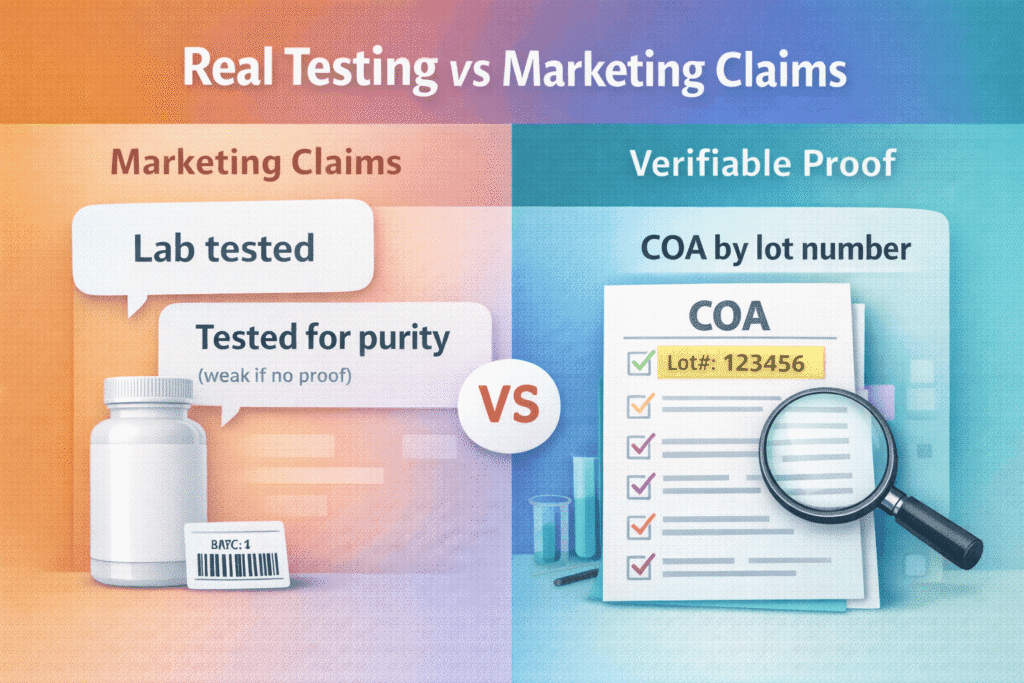
Research Use Only. The information below is provided for educational purposes to help qualified researchers and procurement staff evaluate the documentation that accompanies laboratory reference materials. All products referenced are for laboratory and in-vitro research use only — not for human or animal consumption, medical, therapeutic, or diagnostic use.
A Certificate of Analysis (COA) is the single most important document a peptide supplier can provide, and it is also the easiest one to fake. In a market where several well-known vendors closed or changed hands during 2025 and 2026, and where independent analyses have repeatedly found “research-grade” material that was underpurity, mislabeled, or contaminated, the ability to read a peptide COA critically is now a core research-integrity skill — not a formality.
This guide explains what a COA is, how to read each section, how to distinguish a genuine batch-specific COA from a recycled or fabricated one, and the questions to ask a supplier before you commit to a purchase.
What a peptide Certificate of Analysis actually is
A COA is a laboratory report documenting the analytical testing performed on a specific batch (or “lot”) of material. For research peptides, a credible COA confirms two things independently:
- Purity — how much of the sample is the intended compound versus impurities, byproducts, or residual solvents.
- Identity — confirmation that the compound is actually the peptide named on the label, with the correct molecular mass and sequence.
A document that states a purity percentage but provides no supporting data, or that confirms identity without quantifying purity, is incomplete. A complete COA shows the underlying analytical evidence, not just a summary figure.
The two tests that matter most: HPLC and Mass Spectrometry
Credible peptide COAs are built on two complementary methods. Neither alone is sufficient.
High-Performance Liquid Chromatography (HPLC) measures purity. The output is a chromatogram — a graph with peaks. The main peak represents your target compound; smaller peaks represent impurities. Purity is expressed as the percentage of total peak area attributable to the main peak. For research peptides, independent commentators generally treat ≥96% HPLC purity as the minimum for research-grade material and ≥99% as excellent. A COA claiming a purity figure should include the actual chromatogram so you can see the peak resolution for yourself, not just the number.
Mass Spectrometry (MS) confirms identity. It measures the molecular mass of the compound and compares it against the theoretical mass for the stated sequence. If the observed mass matches the expected mass, you have strong evidence the material is what the label claims. A purity result without a matching mass spec is a purity result for an unidentified compound.
When both are present and both correspond to the same batch, you have a COA that establishes purity and identity for the material actually in the vial.
How to read each section of a peptide COA
A well-formed peptide COA typically contains:
- Product name and sequence — the peptide name and, ideally, the amino acid sequence in single- or three-letter code.
- Batch / lot number — a unique identifier tying this document to a specific production run. This is the field that makes a COA verifiable. Note it; you will use it below.
- Molecular formula and molecular weight — the theoretical values the mass spec result should match.
- Test date — when the analysis was performed. A COA dated years before your purchase, attached to current inventory, is a warning sign (see below).
- HPLC purity result and chromatogram — the percentage plus the graph.
- Mass spectrometry result — the observed mass, ideally with the spectrum.
- Testing laboratory — the name of the lab that performed the analysis, and whether it is the vendor’s own lab or an independent third party.
If any of the first three fields — sequence, batch number, or molecular weight — is missing, the document cannot be independently checked, and its evidentiary value drops sharply.
Batch-specific vs. generic COAs
This is the distinction that separates transparent suppliers from the rest.
A batch-specific COA was generated from the exact production run the vendor is shipping to you. Its lot number matches the lot printed on your vial. It is the only kind of COA that actually tells you about the material you receive.
A generic (or representative) COA is a single document reused across many orders regardless of which batch ships. It may have been genuine for one run at one point in time, but it says nothing about the vial in your hand. A common failure pattern flagged by independent reviewers is exactly this: a vendor advertises “third-party tested” while displaying a COA that is older than the current inventory, so the documentation and the product no longer correspond.
Practical test: ask whether the COA’s lot number will match the lot number on the delivered product. A supplier maintaining true batch-level documentation can answer yes without hesitation and can produce the specific COA for the specific lot on request.
Third-party vs. in-house testing
Who performed the analysis matters as much as what it says. A vendor testing its own material and certifying its own purity is, as one industry write-up put it, grading its own homework. Independent, accredited third-party laboratories performing HPLC and mass spectrometry provide a materially stronger assurance because the party generating the number has no commercial stake in the result. When evaluating a supplier, determine whether COAs originate from an independent lab or from the vendor’s own bench, and give clear preference to the former.
How to spot a fake, recycled, or misleading peptide COA
Fabricated and recycled COAs are common enough that a short verification routine is worth running every time:
- Check that the lot number on the COA matches the lot on the vial. No match, or no lot number at all, means the document does not describe your material.
- Compare the test date to your purchase date. A COA substantially older than current inventory suggests a representative document, not a batch-specific one.
- Confirm the mass spec result matches the stated molecular weight. A mismatch — or a missing mass spec entirely — undermines the identity claim.
- Look at the chromatogram, not just the headline percentage. A stated “99%” with no graph, or a graph whose peaks don’t visibly support the number, is unverified.
- Identify the testing laboratory. An unnamed lab, or the vendor’s own lab presented as independent verification, weakens the certificate.
- Cross-check the vendor itself. Confirm the business exists via a Secretary of State lookup, check domain age with a WHOIS search, review the site’s history on the Wayback Machine, and verify that Privacy, Terms, and Return policies are present. Missing basics correlate with low credibility.
None of these steps require specialized equipment — only a careful reading and a few public lookups.
A quick peptide COA verification checklist
Before purchasing research peptides from any supplier, confirm:
- The COA is batch-specific, and its lot number will match the delivered vial.
- HPLC purity is stated and a chromatogram is provided.
- Mass spectrometry confirms identity, with the observed mass matching the theoretical molecular weight.
- Testing was performed by a named, independent third-party laboratory.
- The test date is consistent with current inventory.
- The vendor has a verifiable business identity and complete site policies.
A supplier that meets every item on this list is providing the level of documentation transparency that serious laboratory work requires.
How SF Bay Area Peptides approaches documentation
SF Bay Area Peptides supplies research compounds for laboratory and in-vitro use only, with documentation practices built around the standards above: batch-level Certificates of Analysis, independent HPLC and mass spectrometry testing, and transparent lot tracking so the paperwork corresponds to the material shipped. Qualified researchers who have questions about the COA for a specific lot are welcome to request it.
Research Use Only. All products and information referenced are intended exclusively for laboratory research and in-vitro use. They are not drugs or medicines, have not been evaluated or approved by the FDA, and are not intended to diagnose, treat, cure, or prevent any disease, nor for any human or animal consumption. Qualified researchers are responsible for lawful handling, storage, and use in compliance with all applicable regulations.